Helpful hints

Ideal office setup

Todd Clarke's ideal office setup taken with iPhone 4s
Todd Clarke's ideal office setup taken with iPhone 4s
Todd Clarke's ideal office setup

Todd Clarke's ideal office setup
Todd Clarke's ideal office setup
Todd Clarke's ideal office setup

Todd Clarke's ideal office setup

Todd Clarke's ideal office setup

Todd Clarke's ideal office setup

Todd Clarke's ideal office setup

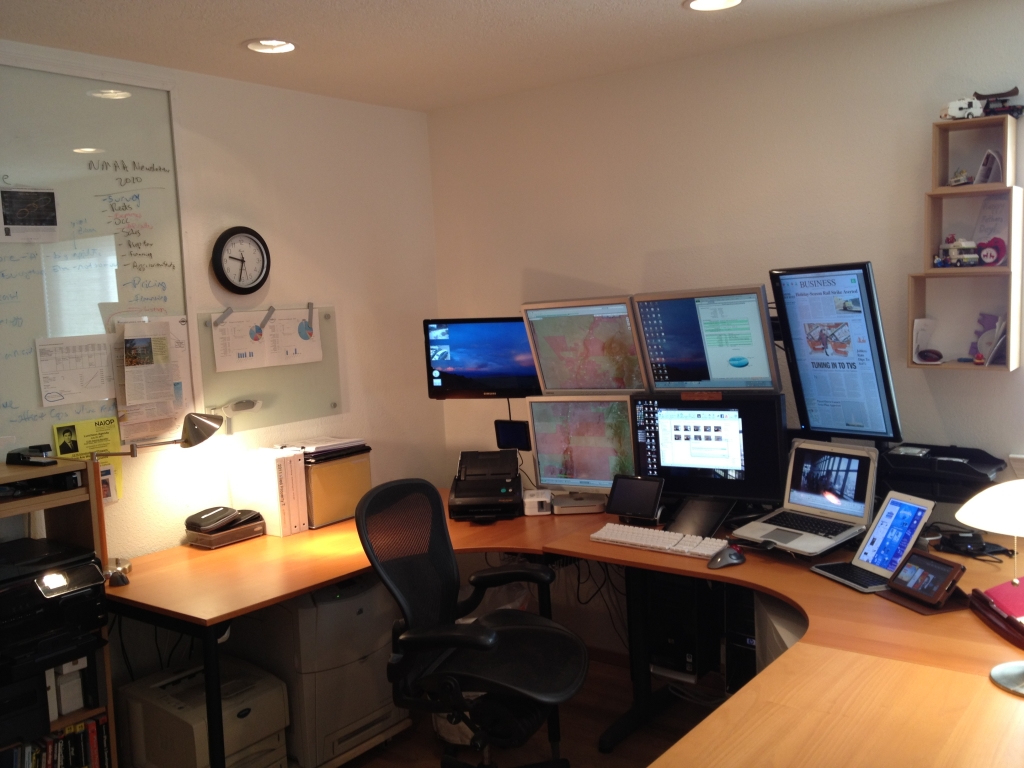
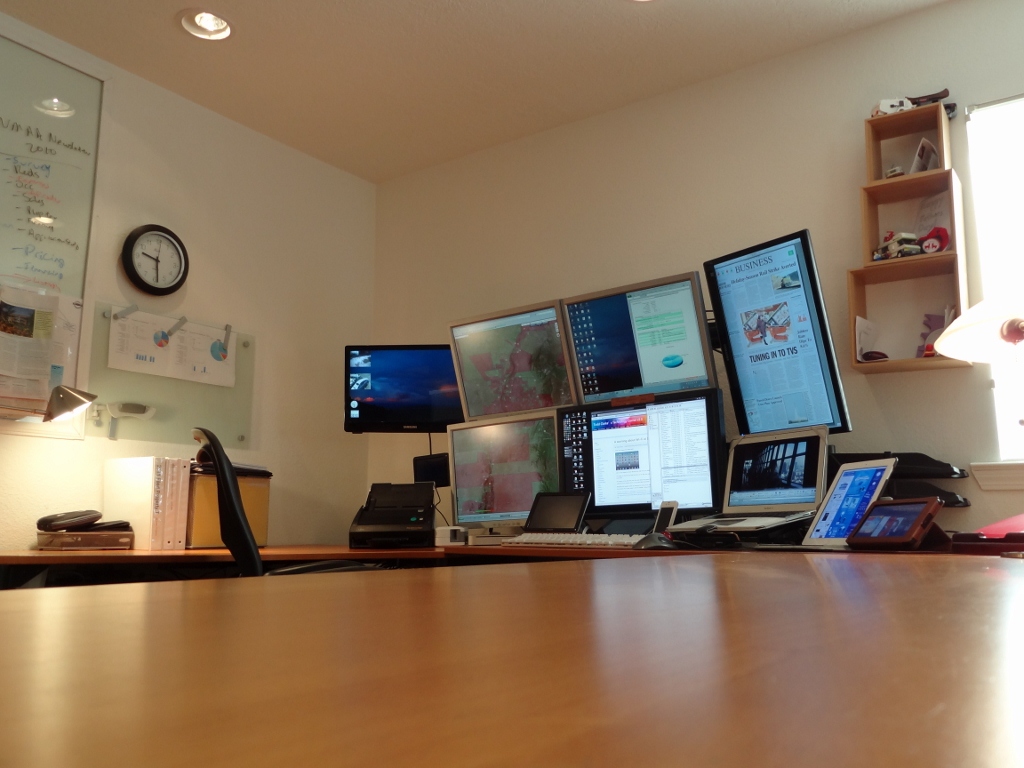
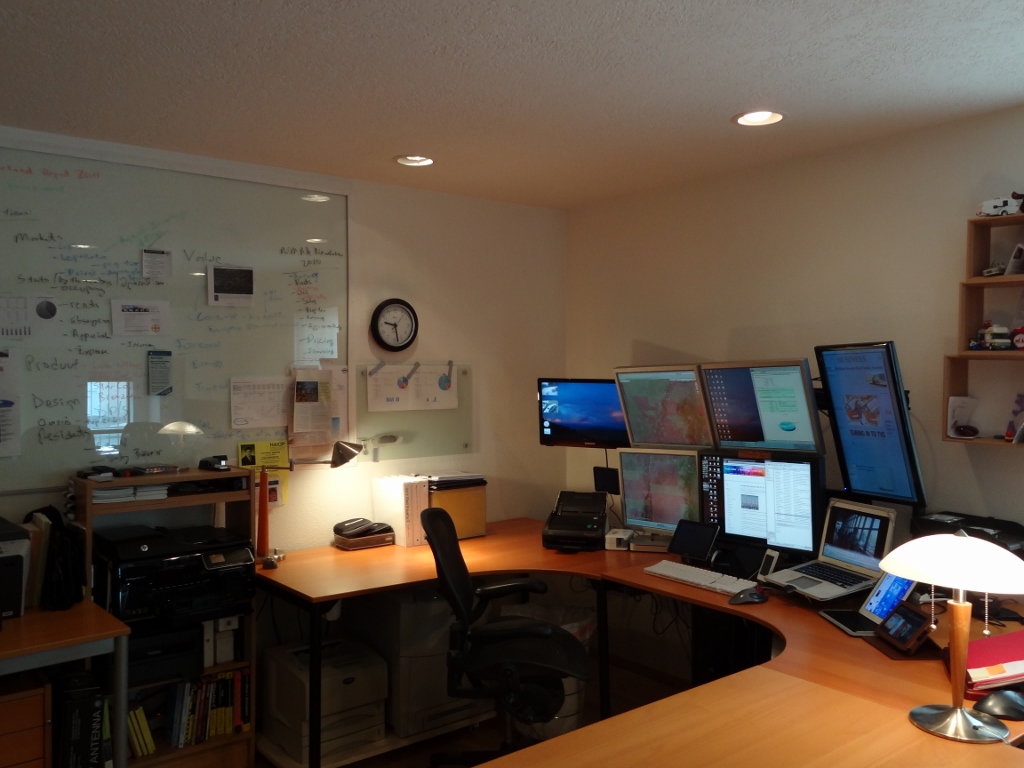
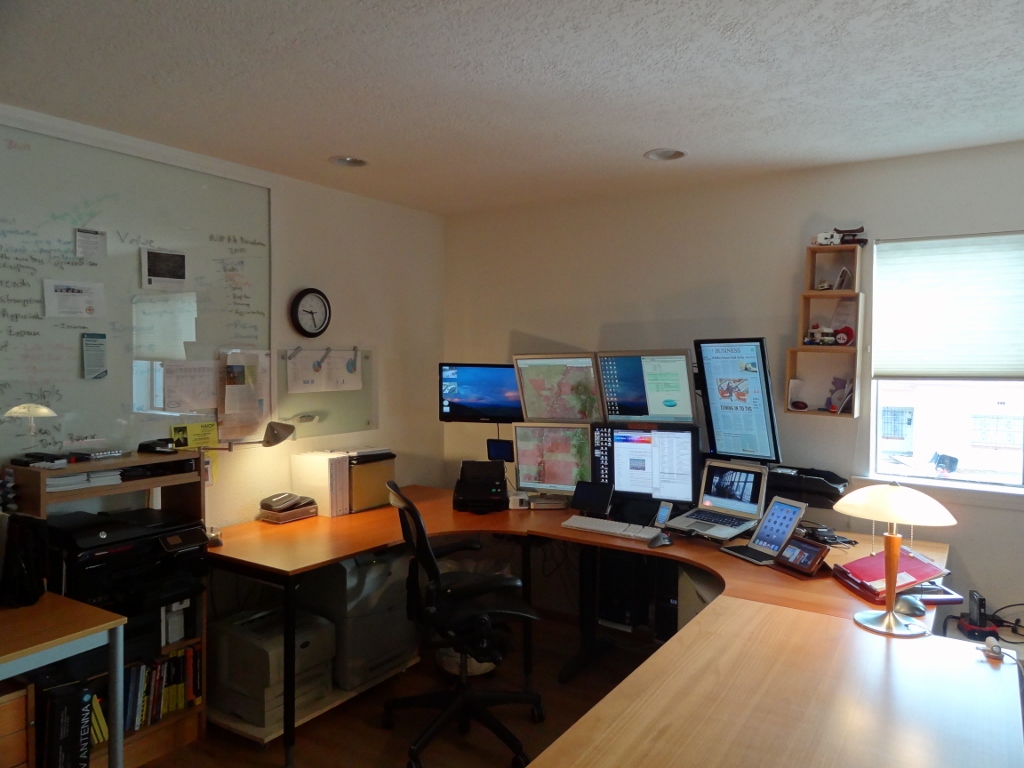
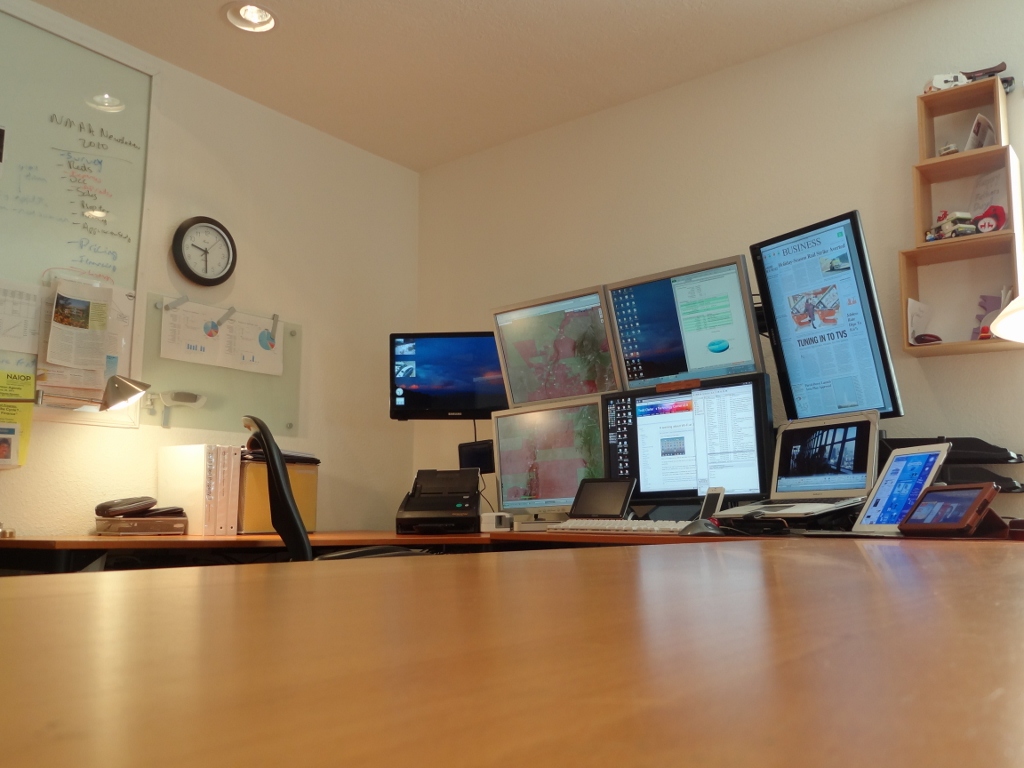
I have been pursuing my ideal office for decades and this arrangement is the closest I have come to a nirvana of office productivity.

What you see here includes 7000 gigabytes (7 terabytes) of storage, 9 screens, 4 computers all controlled by one keyboard and mouse sitting on an Ikea desk. http://www.ikea.com/
Additional equipment on deck includes 2 iPads, one Kindle fire, one iPhone, a Fujitsu Scansnap S510 scanner (for going paperless), a Brother PT-2430PC labeler and of course the all-important Aeron chair.
Most of the monitors are 22” to 24” Samsung’s with a 22” Samsung USB Driven monitor a Phillips Boom Boom monitor and a Mimo 7” USB driven monitor. The desktop computers are redundant setups with a physical keyboard/mouse switch and Multiplicity software that ties them together with the MacbookAir, and the MacMini.

The computers are task driven and run software during the day based on their portability. Starting left working right they include:
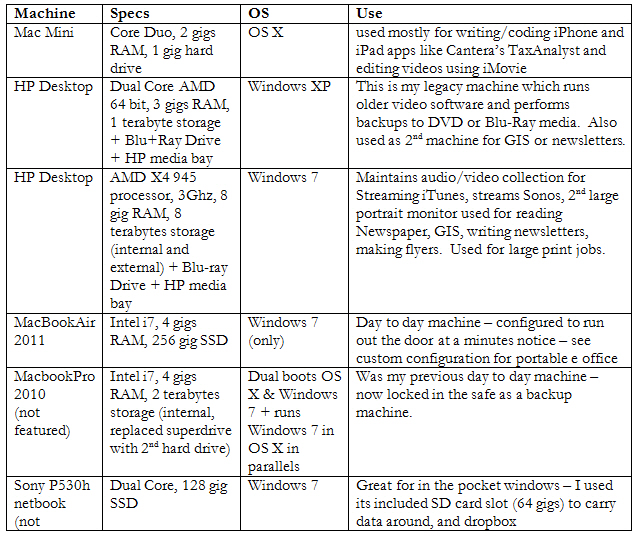
I have found this setup to be very efficient. The two HP desktops run jobs that take a long time – like backups or print runs, or they are used for big projects we have going – stuff that I want to leave up (like maps). The Mac mini is used mostly for coding apps for the iPhone/iPad. The MacbookAir is my main day to day machine – so its running email, contact management, quickbooks, and document management. It is configured in such a way that on a moments notice I can pull its plug and dash out to a meeting.

The glass wall you see to the left of my desk is a 8’ wide x 4’ tall white board that we write on and/or tape things to as we work through projects .

How is your office configured?

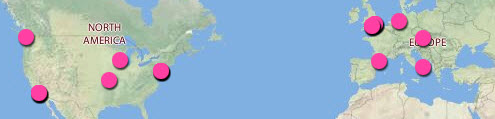
One of my favorite blogs – Lifehacker.com has a great gallery of office setups – including this mobile one or thi sone in a barn – and this map shows where everyone is located that has made a contribution to Lifehackers Workspace show and tell.
Just a few days after I posted this article, I came across this showcase of minimalist office setups.

Technology presentation for the MN/Dakotas CCIM & SIOR Chapters – 11/10/11


Thanks to the MN/Dakotas CCIM chapter and SOIR for a fabulous turnout and a great session!

The list of must have iPad apps can be found here.
and the article I wrote on iPad apps can be found in the Journal of Property Management.

You can also always search our blog for iPad or Apps for the latest news.

and I’ve uploaded yesterday’s powerpoint here MN-CCIM-SIOR-Tech-SocialNetworkingWebinar-11102011.

If you have interest in taking our tech session a bit further and using social networking -click here to watch our Prezi.

A new domain, XXX, and what it could mean to you.

Thanks for the fabulous folks at SouthwestCyberPort (my ISP) for alerting us to this new domain name:

To: SWCP Customers
From: SWCP Tech Support
Subject: [SWCP] Some important information about Domain Names

Greetings. We have a few domain name issues to tell you about. It’s a little
long, so here is an Executive Summary:

1. .xxx domains are launching. If you have a trademark you can block people
from registering your name as a .xxx domain. But only until Oct 7, 2011.

2. Beware fake “renewal invoices” trying to get you to transfer your domain
to another registrar, especially “DROA”.

3. If you have domains registered with other registrars, transfer them to SWCP
to get free renewal tracking and WHOIS privacy.

The longer version:

First, the new “.xxx” domain registry is being launched this fall. It’s
unique among domain registries, and we’ve received several questions about it.
The biggest difference from other domains is that a trademark holder may
purchase a “blocking” registration. That prevents anyone from registering
their trademark in the .xxx domain (without having to register the domain
yourself and pay yearly for a domain you don’t want to use).

The window for blocking registrations closes on October 7, 2011. If you have
a trademark and want to block it, we can help you do it. The cost is $240
one-time and is a “permanent” block. We have more details in a blog posting
on our web site:

http://www.swcp.com/2011/why-you-should-care-about-xxx-domains/

Second is, “beware domain scammers”. We see several different flavors of
unethical behavior around domain registrations. The most common involve
trying to get you to register domains you don’t want, or trying to get you to
transfer your domain to a different registrar, under the guise of an annual
renewal. To call out one company by name, “Domain Registry of America” sends
people transfer requests which are made up to look like a domain renewal
notice. They prey on people who are too busy to check the details. They
respond to the “invoice”, which triggers a transfer of the domain to DROA.
DROA does actually provide domain registration service, so it’s not a complete
scam. But they charge an inflated price and acquire their customers under
false pretenses, which adds up to a scam in our book.

Another common scam email we see is a notice that someone else is trying to
register a domain with your company name in another country. The other
country is almost always China. For example if you own company.com, they tell
you someone is registering company.com.cn and implore you to register it
before they get it first. We have also seen the same scam regarding the “.us”
domain.

And finally, a note about domain renewals with non-SWCP registrars. SWCP
partners with OpenSRS/Tucows for domain registrations. We have been using
OpenSRS for over 10 years. Our combined system includes robust renewal
tracking. When one of our customer domains comes up for renewal, we email
them about 6 weeks in advance to notify them, with weekly reminders. If we
don’t get any response, we will contact them by phone. We do everything in
our power to make sure they know their domain is in danger of lapsing.

Most other registrars rely only on email notifications. About once a month,
we encounter a customer whose domain has expired by mistake. Usually they
can recover the domain the same day, but in some cases it takes longer. If
the domain owner doesn’t notice for a long period of time, the domain can even
be lost altogether (there are “domain squatters” who troll the daily lists of
expiring domains to snap up domains they think might be valuable either as
domains, or to hold for ransom).

If you would like to transfer your domain from another registrar to SWCP, just
let us know (email help@swcp.com). The transfer costs $20, and extends the
current registration period by one year. If you aren’t sure where your
domain is registered, you can check at our domain tracking web page here:

https://members.swcp.com/domains/

Log in with your SWCP username and password. We list all of the domains we
provide any services for. If the Expiration Date of a domain is listed as
“UNKNOWN”, that means the domain is registered with another registrar. If the
Expiration Date is shown, that means the domain is already with SWCP/OpenSRS
and is in our renewal tracking system.

Or feel free to ask us by email and we will check the status of your domains
an report back. We can also tell you who the current registrar is for each
domain.

Oh, one more benefit to using SWCP/OpenSRS as your registrar: Free WHOIS
Privacy. If you would like us to enable “WHOIS Privacy” on your domain, just
let us know. This removes your personal information from the public WHOIS
records, which can reduce the amount of spam you receive.

If you have any questions about any of this, please contact us by phone or
email.


Mark Costlow
help@swcp.com

So why the concern? Imagine you are running for office, or running a business and someone bought yourname.xxx (fill in your name) and was able to post anything they wanted on it. Coming that with Photoshop and viola, you’ve got a bad combo for having your brand “hijacked”.

A neat feature found in the Kindle- sharing!

No, I don’t mean the ability for your Kindle to share its books with other Kindles.

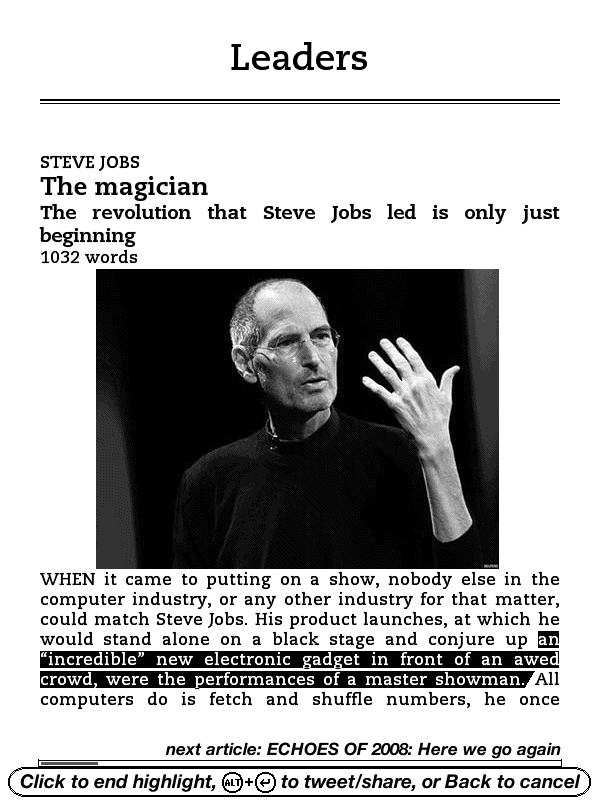
What I am speaking of is the feature in Kindle that allows you to highlight some text then hit two keys to have that highlight and your comments pushed to Facebook and Twitter.

Previously, I used Kindles clipping menu, then I had to hook the Kindle into my laptop, copy the file, login in to Facebook and Twitter and post – an easy 10 minutes has now been saved – thank you Amazon!

This is what the post looks like in Facebook:

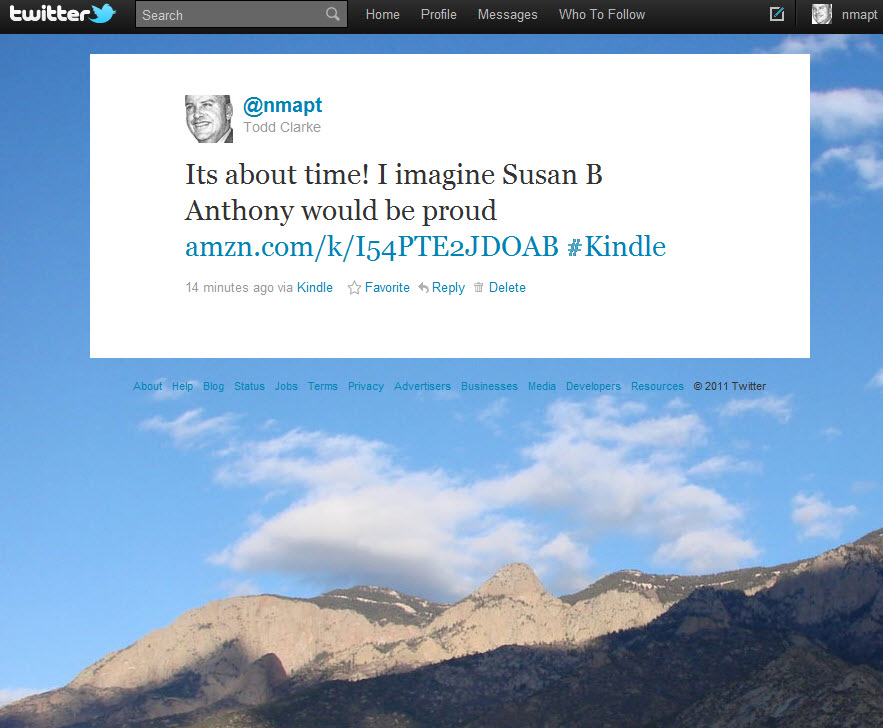
This is what the post looks like in Twitter:
And this is what the results look like for the user:

Email dont’s

The email below was recently shared with me, and I thought it was a perfect example of the need for people to obtain a “license” to email before they just broadcast to the world. The exchanged occured between a proffesional consultant who sent out an email to a group of stakeholders and one of those stakeholders who was surprsied that their email had been made “public” by putting it in a carbon copy field as opposed to the blind carbon copy. The following is a verbatim (except for correction of typo’s) response to the original email:

“You are one of my best…and few chances… to witness spontaneous human combustion since you are such a flaming dither-wit. Will you publicly give me a physical address so I can observe this phenomenon? Oh, you just did that. I can find it.

Do you have any inkling of what you have done?

I have asked that my name be removed from this open broadcast list/list serve OR that this info be sent blind carbon copy (bcc). I cited past undesirable experience as the basis for my request.

You assured me first…that you would remove my name from this list, and then continued that you did not know if you could remember to copy me separately. I am still on this open list. You did NOT remove me as I requested.

Then you sent an email saying you had learned how to do a bcc. No worries…problem fixed,

Apparently neither statement is true.

I consider your inability to competently facilitate secure communication to be inexcusable. Are we clear on this? Your blatant disregard for my privacy and electronic security, as well as that of every person on this email broadcast list, is exceeded only by your inattention to both detail and your ineptness with very basic communication technologies.

You do have firewalls…correct?….and your AOL account has state of the art virus/malware detectors and everyone on this list is protected. Correct?

Until you learn how to use this technology safely REMOVE ME FROM THIS LIST.

Are we clear on this?”

If you are new to internet and email, this link will provide some background information on email etiquette and this link is an interesting white paper on how email flames get started.

Lacking that, I would stick with a quote I once heard “if you see someone coming at you with an email address that ends in .aol, RUN!

Finally, my own personal opinion is that you tell so much about yourself by using an AOL email address, very little of which is positive. The only way you could expand on that faux pas would be to use an AOL email for business. (If you have no clue what am I am talking about, consider registering your own domain name and using that address for your email.)

QR Codes in Kyoto


Having long written about the benefits of using QR Codes, imagine my surprise when I came across this real estate sign in Kyoto that included a QR code!
iPhone Tethering

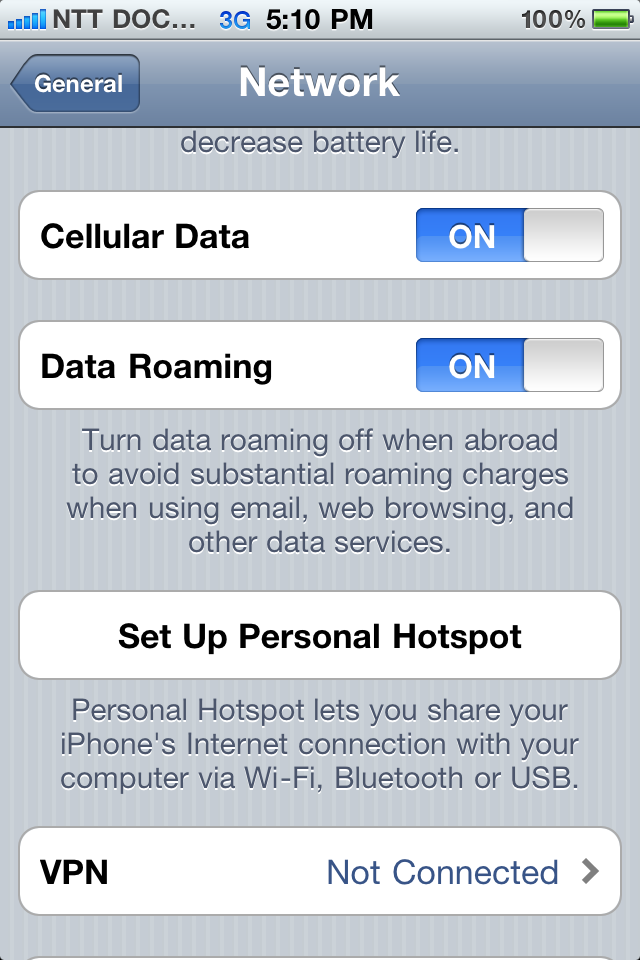
It’s interesting to note that while my AT&T iPhone doesn’t allow tethering in the United States, when I crossed in to Japan to teach a CCIM course, NTT DOCOMO had activated tethering. My iPad2 did not recognize Japanese providers at all, fortunatley we had brought with us the an international MiFi.

It’s a shame we can’t do the same in the U.S.A.

My must have list of Apps for my iPad2

Goodreader – porting PDF files around
iBooks – showcasing listings/assignments/reports in PDF
Pages – similar to Microsoft Word
Numbers – similar to Microsoft Excel
Keynote – similar to Microsoft PowerPoint
Quick Office – (similar to above) –
Dropbox – for accessing files on the road
Pogoplug – similar to dropbox, but it physically exists in your office
Wikipanion – research using Wikipedia.org – HootSuite – managing social networks

http://itunes.apple.com/us/app/hootsuite-for-twitter/id341249709?mt=8

BAO (demographics)

QR Scan – reading QR Codes –

Loopnet – finding listings –

Photosynth – assembling cool photos in collage format –

Magicplan – measuring space (requires iPad2)

10bii cash (calculator)

WordPress (for updating our websites and blogs) –

Not necessary to have, but might be interesting:
And the app we wrote for property taxes in Bernalillo County – Taxessor
And an interesting app that shows the potential of what your own app could like –

Rock Melt – a new social networking browser?

A new browser, or actually, to be technically correct, a new browser interface built on top of Google’s Chrome Browser, has entered the market.

RockMelt offers social networking and feed options along the margins of your browser. Now Facebook and your internet surfing can co-exist in the same window frame.

I have to admit the interface is very compelling and easy to use.

Available as a browser on the PC, MAC and an App for iPhone and the Ipad .

How to earn a 207% IRR by moving towards a paperless office

–Authors note – this article was published in the March/April 2008 issue of CIRE Magazine .

Looking for a phenomenal return on investment? Want to increase services while gaining a competitive advantage? Believe it or not, a modest investment in technology coupled with a modified work flow process could be one of the best investments you make in 2008.

The biggest gains in a paperless office can generally be found in six arenas:
- Increased turn around in document management: no more waiting for snail mail, faxes or even overnight delivery – pull together files for your clients on a moments notice
- Improvement in staff efficiency: reducing your staffs or agents time spent in fax queues, preparing snail mail, or filing documents by moving digital documents around at their own convenience
- Severing the chain to the office: a small laptop filled with you all of your documents and an always on internet connection is all your sales force needs to be productive whether they are in the home town or in the field doing business
- Reduction in storage: take a quick inventory of your office and storage units – how much are you paying to store your client’s paper? As a rough rule of thumb, an entire file cabinet will fill one 4.7 gigabyte DVD disc.
- Competitive advantage: being able to move documents at the speed of a mouse is advantage to your client that you should be promoted at every opportunity. Maintaining an always accessible backup of your client’s important documents enhances the chances of return business.
- Backups: You do have one right? I don’t mean of your harddrive – what happened if your office had a fire tomorrow – where is the backup of that file cabinet? Backing up decades of digital documents can be done in less than one half day and then moved offsite or out of state for truly effective backups.

Physical Needs/Tools:
Monitor
The most important tool in a paperless office is a monitor or two that support two 8.5”x 11” documents side by side – allowing the user to work on one document while reviewing the other. If you find yourself printing a document to review it, your already one step backwards from the efficiency of a truly paperless office. Most laptops made in the last four years support two screens (laptop + monitor) or any of Samsung’s large screen monitors (21”+ at 1600×1200 or higher resolution) do a great job with supporting multiple documents on one screen. If you are a fan or follower of the Edward Tufte design philosophies, you know the higher the resolution the better.

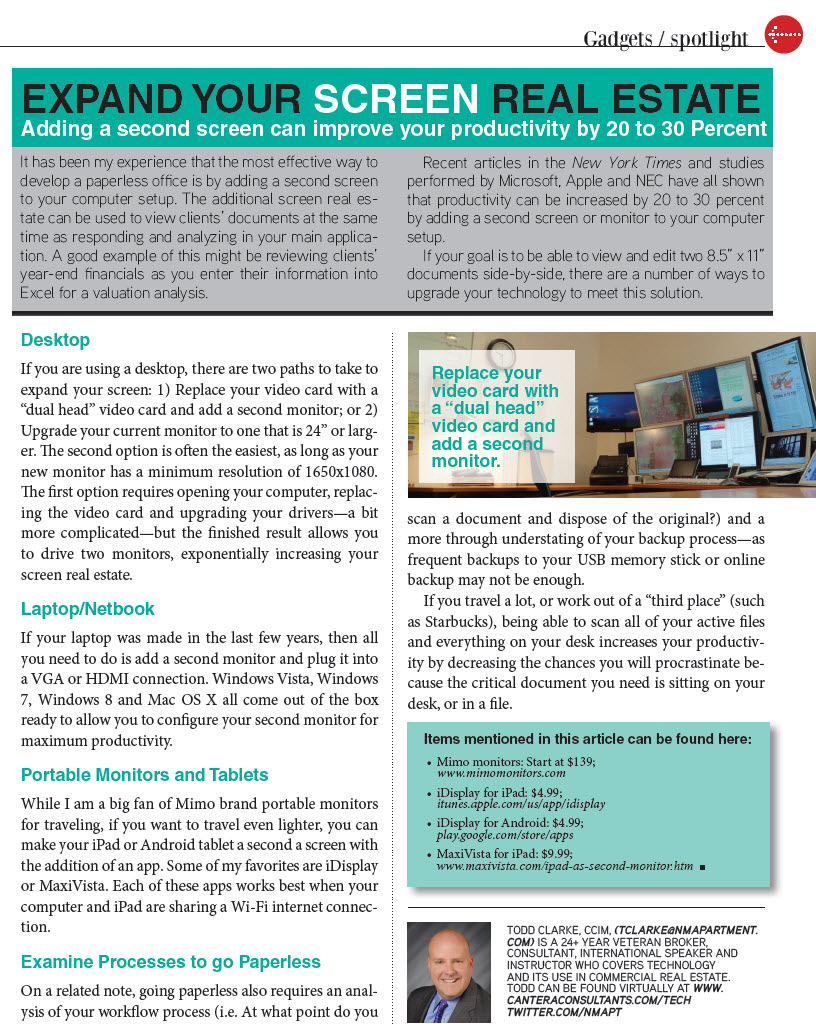
This photo gives you an idea of my paperless office.

Laptop It goes without saying that you need a computer to make the paperless office work – but contemplate a new small laptop – one that weighs less than 3 lbs. (I currently use the Sony P and a MacbookPro (running Windows 7 95% of the time)). If your laptop is easy to carry then you are much more likely to take it with you to meetings or home, so size does matter. While you are at it, seek out a laptop with an always on Internet, also called WWAN connection – being able to fax or email a document to a client from your remote cabin location 180 miles from your favorite Kinko’s is genuinely convenient. For the ultimate in portability – consider a laptop like the any of the small netbooks made by HP, Acer, Asus or others they often weighs about two pounds, and are powerful enough to run Windows 7 and can be outfitted with hardrives up to 500 gigabytes – enough to hold a century of transactions.

A digital fax service Don’t think of a fax machine as a piece of hardware anchored in your office but rather as a client driven scanner to your digital file cabinet. Whether you use jFax, efax or another service doesn’t really matter – what does matter is dumping your fax machine in the dumpster as soon as possible – moving to an always on fax service that allows you to send and receive faxes in your email box is worth the $9.95 to $14.95 these services charge monthly. An additional fee will gain you a toll-free fax that your clients will truly love.

Scanner This is one component of your hardware that is important to be brand specific. Our office has tried dozens of all in one devices, photo scanners, and even paper scanners to end with one recommendation – any of the Fujitsu Scansnap scanners – these devices hold 30 pages, scan both sides of a page in seconds, recoge color on the fly and save to a PDF format with the press of one button.

Fujitsu has a number of models that I use including the S510 for my desktop, the S1300 for extended trips, and the S1100 for scanning contracts during the day.

Fujitsu Scansnap S510 – desktop model – very sold and scans

*Fujitsu has replaced the S510 with the S1500

Fujitsu Scansnap S1300 – portable – and powers off two USB ports

Fujitsu Scansnap S1100 – portable – weighs less than 1 lb

On another note, while fancy expensive office mopiers or multifunction scanners/printers/copiers are very high tech, you’ve just moved the inefficient waiting in line from the fax machine to the new device – far better to have a scanner on each desk as you work towards freeing your documents from their digital analog format.

If you have large format documents – add the phone number for the local architectural supply company to your speed dial as they can scan and convert building plans to a PDF format on a CDROM for a nominal fee.

Software On the software side of things, only two tools are needed – one to read/edit/manipulate documents and another to search them.

For the creation, reading, and filing of digital documents, the industry standard is Adobe Acrobat – seek out version 7 or higher and be content knowing you will most likely never use 95% of what the software has to offer. Before you consider another piece of software, fast forward twenty years and make your best guess as to what software will be able to read a 20 year old document.

Using an effective search engine tool that can read your documents like the one included in Windows 7, or the free Google desktop search will assist users who are organizationally impaired.

Legal Considerations This year celebrated the 25th anniversary of the personal computer and the 7th anniversary since President Clinton signed the and yet most businesses still lurch around with a file cabinet on their back with the incorrect impression that they are required to keep documents in a paper format. Check with your local Real Estate Commission and if you are met with resistence, remind them of President Clinton’s bill known as the Electronic Signatures in Global and National Commerce Act and is known as “E-SIGN”. This Act requires governments to support the move to digital documents.

The Return And where did that fantastic IRR calculation come from?

The Process Facing the overwhelming number of files and documents to scan, many professionals resist the conversion to digital paper hoping for an easier solution, or a new year’s resolution to start afresh.

While technology is a necessary component for the paperless office, equally important is the adoption of a process to integrate digital documents in your workflow. These steps include implementing a policy for when documents are scanned, physically scanning documents, organizing documents for storage, developing a backup system for digital documents and implementing a process to allow you or your clients to retrieve documents easily.

When to Scan While some firms scan documents the moment they physically enter their space, other firms wait until the document is put into “action” or are going to be transmitted to other parties. Before you start scanning documents consider what process works best with your current workflow. At NM Apartment Advisors, our agents scan documents upon receipt, allowing them to carry all of their files in a two pound notebook, 24/7/365.

Who Scans Ownership of files can often be equated with the person who is responsible for scanning files – we have discovered that if it is your file and your client, you are much more likely to spend the time making sure all pages are scanned, and naming the file in a conventional format that allows for an a quick easy scan any file folder to find the correct document. Our naming convention includes everything anyone would need to decipher what is in the file without having to read it – this includes property name, city, client’s name, type of document, status, version and date. So a purchase agreement signed by the seller on a property located at 6101 Sequoia NW might be named something like [ your data directory\listings\6101SequoiaNWABQ\PurchaseAgreement-BuyerAllied-SignedbySeller-12182007.pdf ] .

How to organize storage As the file is named, it must also be stored in a process that matches your office setup – so in our office, all agent’s have a data directory and nested inside of that they have organized their files in the most accessed to least accessed system – so their top directories are active listings and client’s, while their bottom directories are archived deals, closing, and client files.

Let’s assume you have a central DATA or MY DOCUMENTS directory – the folders inside of it might be nested like so:
Directory Name Used for Logic
0-Day2Day\ Email, Outlook, Palm files, Quickbooks These files are being accessed hourly
1-Listings\ Current properties – could be further disaggregated by type (land, multifamily, office, etc.) These files are being accessed daily/weekly
2-Clients\ Use a naming convention that matches your customer relationship manager AND you may have multiple clients in this directory (i.e. USAA_ TX_deal, USAA_NM_deal, etc.) These files are being accessed daily/weekly
3-Personal\ Store your resume, letters to friends, all those bad internet jokes, etc. here These files are being accessed weekly/monthly
4-Family\ This is where you store the cute pictures of your kids, your vacation plans, family budgets, etc. These files are being accessed monthly/quarterly
5-ArchivedListings\ Once a deal is closed this is where it goes until you get a chance to sell it again These files are being accessed quarterly/annually
6-ArchivedClients\ Once a customer completes a transaction on a property this is where it goes until you get a chance to sell it again These files are being accessed quarterly/annually
7-ArchivedPersonal\ Past resumes, former jobs, etc. are moved here These files are being accessed quarterly/annually
8-ArchivedFamily\ Past vacations, old photos, previous school years homework, etc. are moved here These files are being accessed quarterly/annually
9-Misc\ Anything you’ve scanned that you may not want to keep These files are being accessed monthly/quarterly

By labeling your directories names with a beginning number, you can match directories (1 & 5 are deals, 2 & 6 are clients, etc.) AND you can tap the number on the keyboard as a shortcut to moving to that directory.

Finally, in Windows XP or Vista – the user can right click on any given data directory and SEND TO – COMPRESSED FILE to create one .zip file that can be sent to co-workers, clients, the qualifying broker, etc.

Backups By organizing your data based on frequency of use, you’ve the backup process even easier. Daily information can be backed up in a few minutes using an inexpensive 4, 8, or 12 gigabyte USB drive. Weekly backups can be burned to DVD discs which hold 4.7 gigabytes in a matter of an hour or so, while monthly backups can be performed on all of the data to Blu-Ray discs which hold 25 to 50 gigabytes and take four hours or so to backup.

As a temporary backup, external data drives varying in capacity from 160 gigabytes to 2 terabytes can be purchased and connected inexpensively through the USB 2.0 or Firewire ports. Keep in mind that these drives have a limited lifespan and are subject to the same issues of safety and security that your laptop or desktop is – so they should only be used to move data from machine to machine or as a temporary backup lacking anything else.

Automated network backup systems work well, but require the user to be connected to the office network and physically limit your backups to one location – so use these only for interim backups.

Avoid at all costs medium or devices that are specialized in nature or that can be easily altered by the physical environment – this includes tape drives, Boolean drives, or any of the various drive cartridges. If you need to access that data on that medium in 10 years and that company is out of business will you be trolling on eBay for a 10 year old piece of technology to restore your old data?

Web based back ups, while convenient, bring into question who owns your data, who has access to your data, and what happens to your data if the backup company becomes victim of the next dot bomb era.

Depending on the amount of data that must be stored, the best final backup medium is CD-R, DVD-R or Blu-Ray. If kept in a nice scratch proof CD folio in a dark location, like a bank safe deposit box, these discs can be readily read on future format drives decades from now.

Years from now, you will be ecstatic you made monthly backups as files often become infected or corrupted, and being able to go back one month or many months prior to that backup and find a clean file is invaluable.

Client Access Whether you develop your own, pay a subscription based service or use any of the many title company services, there are an abundance of web based tools that allow you to create a virtual closing room to upload your files. This provides your client’s 24/7/365 access to the status of their transaction as well as all of the relevant files.

Envision the day when you leave the office, desk clear of all paper and clutter, all of your information secure in your two pound laptop, improving your efficiency, and offering a competitive advantage to your clients, and of course, how many places can you achieve a 207% IRR.

** If you find topics like this valuable, the consider attending the CCIM’s Ward Center for Real Estate Studies – Technology and Social Networking course http://www.ccim.com/education/course/TSN/TSN0001 . This Chicago based course is an all day course scheduled for April 5th, 2011.